

Artículo: The Best View in Florence You Shouldn’t Miss
The Best View in Florence You Shouldn’t Miss
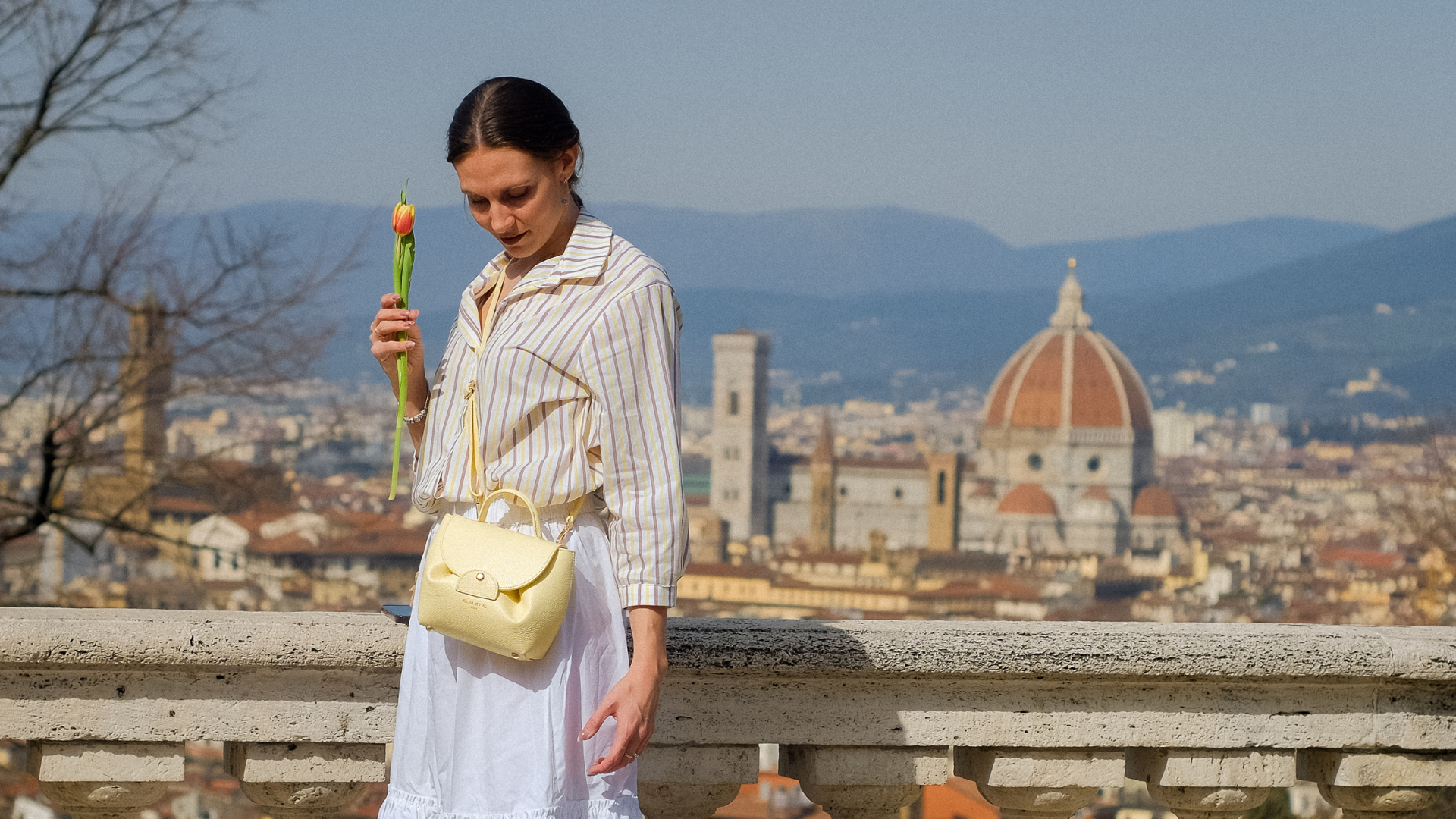
Piazzale Michelangelo is one of those places in Florence where everything comes together naturally. The history of the city, its artistic heritage, and the landscape all meet in a single point, creating a perspective that feels complete. It is exactly this balance that made it the perfect location for our photoshoot.
Spring in Florence has a very specific atmosphere. The light is softer, the air feels lighter, and the city slowly opens up again after the winter months. From Piazzale Michelangelo, this seasonal shift becomes even more visible. The hills around the city start to turn green, the Arno reflects a clearer light, and the rooftops take on warmer tones. Shooting here in this moment of the year allowed us to capture not only the bags, but also a feeling that is closely tied to Florence itself.
The piazzale was designed in 1869 by Giuseppe Poggi as part of a larger project to rethink the city when Florence briefly became the capital of Italy. It was conceived as a panoramic terrace dedicated to Michelangelo, and even today that original idea is still very clear. The space does not try to compete with the city, it simply frames it. At the center, the bronze copy of David stands as a quiet reference to the artist, while the real focus remains the view that opens just beyond it. From this height, Florence reveals itself in a way that is difficult to experience from within its streets. The Duomo rises above everything, with its dome becoming a clear point of reference. Palazzo Vecchio stretches vertically with its tower, while Santa Croce sits slightly apart, creating a rhythm across the skyline. The Arno cuts through the city with a calm, horizontal line, and the bridges connect the two sides in a way that feels almost graphic when seen from above.
For our photos, this perspective became essential. The clean lines of the city, the contrast between stone, sky, and greenery, and the depth created by the distance all worked as a natural backdrop. Nothing felt forced. The setting added context without taking attention away from the product. It is a place where structure and softness coexist, much like the approach behind Sara by JG.
There is also something about the way the piazzale was designed that supports this kind of visual storytelling. It was never meant to be a closed or decorative space. The wide open terrace, the gradual ascent leading up to it, and the loggia above, originally intended to house a museum dedicated to Michelangelo, all contribute to a sense of openness. Even though that museum was never completed, the structure remains, adding another layer to the space without interrupting its simplicity. Being there also means stepping slightly outside the rhythm of the city. While the historic center can feel dense and busy, Piazzale Michelangelo offers space. This sense of distance creates a different kind of connection, one that is more reflective. For a brand that focuses on craftsmanship and thoughtful design, this environment felt aligned with the values we wanted to communicate.
Choosing this location was not only about aesthetics. It was about context. Florence is a city built on art, on attention to detail, and on a strong relationship between past and present. Shooting at Piazzale Michelangelo allowed us to place our work within that narrative, without needing to overstate it. The view speaks for itself, and in doing so, it naturally enhances everything that is placed within it.

De Sara JG

Dejar un comentario
Este sitio está protegido por hCaptcha y se aplican la Política de privacidad de hCaptcha y los Términos del servicio.